Sales and Inventory Forecasting

Forecasting demand and managing inventory belong to areas where real-world behavior is highly complex. In practice, several irregular influences interact at the same time:

  • products have different seasonal patterns
  • promotional activities can completely reshape customer behavior in the short term
  • some items have stable consumption, others fluctuate based on weather or trends
  • stockouts, price changes or newly listed products can break any simple pattern


This is exactly why AI and modern forecasting methods are increasingly used today. They are not “sci-fi”, but tools capable of identifying patterns in data that people can’t realistically hold in their heads. Traditional approaches like moving averages or basic statistical models work well where demand is stable, but they quickly hit their limits in more complex categories.

Modern machine learning and deep learning models can work with multiple data sources simultaneously, capture seasonality and irregularities, and often uncover patterns that would be impossible to assemble manually.

The aim of this article is to outline three main families of forecasting approaches:

  • classical statistical methods
  • modern machine learning models
  • advanced deep learning architectures


and explain where simple tools are sufficient and where it makes sense to use more sophisticated techniques.

Comparing the Approaches: Statistics, ML and DL

In practice there are three main directions for demand forecasting (leaving aside LLMs, which are designed for text rather than time series). These approaches are not competitors, but different tools for different types of problems.

Statistical Methods (ARIMA, Moving Averages)

These are among the simplest methods. They assume that the future will behave similarly to the past.

Where they work well:
  • stable demand
  • simple seasonal patterns
  • short-term forecasts with a clear trend
Advantages:
  • fast, simple and inexpensive
  • low data requirements
  • easy to implement
Limitations:
  • poor handling of nonlinear behavior
  • fail when promo effects, fluctuations or combined influences appear
  • cannot work with multiple input types (price, promo, weather…)

Classical ML (Random Forest, XGBoost, LightGBM)

These models search for relationships between many inputs and outputs, without trying to describe the series with one equation.

Where they work well:
  • mildly to moderately complex product behavior
  • many inputs: season, price, promo, location, product type
  • nonlinear patterns
Advantages:
  • flexible
  • capture nonlinearities
  • more robust to noise than statistics
  • still relatively easy to deploy
Limitations:
  • do not understand time on their own → require feature engineering
  • hyperparameter tuning can be demanding
  • not ideal for highly complex scenarios

Advanced Deep Learning (LSTM, TCN, Transformers / TFT)

Deep learning models can learn how a time series behaves directly from data. They identify patterns automatically.

Where they work best:
  • strong or irregular seasonality
  • a variety of promo effects
  • complex structures (product → group → warehouse)
  • dynamic environments with many simultaneous factors
Advantages:
  • highest accuracy on complex datasets
  • capture long-term temporal relationships
  • minimal need for manual feature creation
  • long patterns
Limitations:
  • high complexity
  • greater computational and data requirements
  • need longer historical records
  • poorly configured models may perform worse than simple statistics

Summary

  • Statistics: works for simple scenarios with stable demand.
  • ML: strong balance between complexity and performance.
  • DL: maximum accuracy where data and behavior are genuinely complex.
  •  

Real-World Comparison

In the real world, an “ideal” product assortment almost never exists. Instead, we typically see a mix of:

  • stable products
  • seasonal items
  • promo-driven categories
  • weather-sensitive items
  • products with limited history
  • irregular and erratic behavior


And all of that is further complicated by category differences, price changes, data errors, local specifics and human decisions. One of the most common issues is poor selection of inputs. Models often receive too little (because some factors are taken for granted and never passed in), or too much (irrelevant variables introducing noise). The goal of a model is not to explain causality — it needs clear and relevant signals.

How Each Approach Performs

Statistics
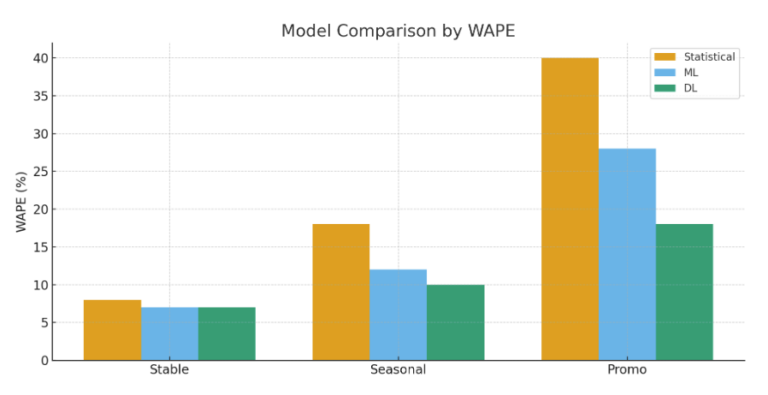
  • Stable products: works very well
  • Seasonal products: works if seasonality is regular; irregularity breaks it
  • Unstable products: promo + weather + availability cannot be distinguished

Impact: inaccuracies, overstocks or stockouts.

Classical ML
  • Stable products: good, but statistics is enough
  • Seasonal products: handles irregular seasonality with proper features
  • Promo products: significant improvement with correct inputs

Impact: fewer stockouts, lower inventory, better handling of promo effects.

Advanced DL
  • Stable products: statistical models suffice
  • Seasonal products: similar to ML, better in irregular cases
  • Promo products: clearly superior, handles chaos and multi-factor behavior

Impact: for highly complex products, accuracy may improve by 20–40% compared to ML.

Choosing the Right Approach

DL models are the most powerful, but that doesn’t mean they’re always the right choice. It is important to evaluate:

  • portfolio complexity
  • available inputs
  • data quality and history
  • economic impact of forecasting errors


Sometimes the investment into a complex model pays off immediately; sometimes the improvement over ML or statistics is minimal. DL models shine where accuracy has high business value: volatile products, promo-driven categories, short shelf-life or high-value items.

Choosing the Right Approach

  • higher accuracy → optimized inventory → lower costs
  • fewer stockouts → higher sales
  • better reaction to promo effects and short-term fluctuations
  • ability to learn patterns not visible at first glance
Product TypeImprovementInventory ImpactStockout Impact
Stable1–3 %MinimalNone
Seasonal8–12 %inventory reduction 3–5 %Fewer stockouts
Promo / Irregular20–40 %inventory reduction 10–20 %Fewer stockouts, higher revenue

How to Start Without Building an Internal Data Science Team

DL models often look like something only large companies with dedicated data teams can handle. Fortunately, the landscape has changed. Libraries, frameworks and automated tools take over most of the heavy lifting. You don’t need a three-person data science team and a year of development.

Start Simple: Baseline First

Don’t jump straight into the most complex model. A better path:

  • test a simple statistical or ML model
  • compare predictions with reality
  • evaluate data quality
  • identify whether advanced models are likely to help


A baseline is your reference point. Without it, you cannot tell if a more complex approach is worth it.

Use Existing Tools Instead of Building Everything from Scratch

Modern frameworks allow you to:

  • adjust model parameters
  • add or remove features
  • monitor changes in forecasting accuracy


The principle is simple: test first, adjust later.

Focus on Problematic Products

Not every item needs a DL model. Start with categories where prediction errors hurt the most:

  • promo-driven products
  • irregular seasonal items
  • products influenced by many factors


A small targeted use case can reveal most of the value.

Find a Partner for the Technical Work

It is unrealistic to expect every company to tune architectures, features and hyperparameters. A more practical approach is:

  • have someone internally who understands the business,
  • and a partner who covers the technical side: design, testing, tuning, integration.


This allows you to focus on what matters: whether the model improves decision-making and reduces costs.

Subscribe for Latest News

You have been successfully Subscribed! Ops! Something went wrong, please try again.

Better forecasting thanks to AI

Business Info.

IČO: 172 28 018

DIČ: CZ 172 28 018

Data Box ID: ykwdnxf

sales@neebile.cz

Jičínská 226/17, Praha, Žižkov, PSČ 130 00 Česká republika

(910) 658-2992

© 2025 Vytvořeno DigitalWays