After three years of deep study in AI, I decided to launch my own project: applying deep learning to inventory forecasting.
Why this topic? A colleague asked me whether artificial intelligence could help solve inventory planning problems in a wholesale business.
It quickly became clear that inventory management is a never-ending balancing act — too much stock means unnecessary costs, too little means lost sales and frustrated customers. On top of that, many dynamic factors come into play.
The goal of this series is to make the world of inventory forecasting with AI accessible to business professionals — those who deal with operations and inventory planning in practice and want to understand how AI and modern data tools can help.
I won’t dive into technical details. Instead, I’ll focus on real-world challenges and how I addressed them. Each article will present a specific problem, show how I tackled it, and support it with examples or charts — so you can get a clear picture of what AI can (and can’t) do in supply chain forecasting.
My aim is to provide value both to business managers who want to explore AI’s potential and to analysts interested in how data handling and modeling decisions impact forecasting results. All data used in this series come from real projects, but have been anonymized. New articles will be published progressively, as I gather new insights and practical examples.
To build a system that can:
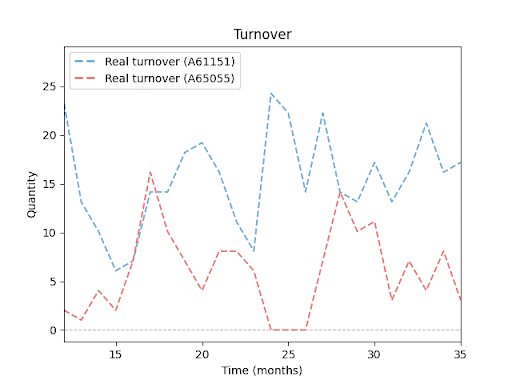
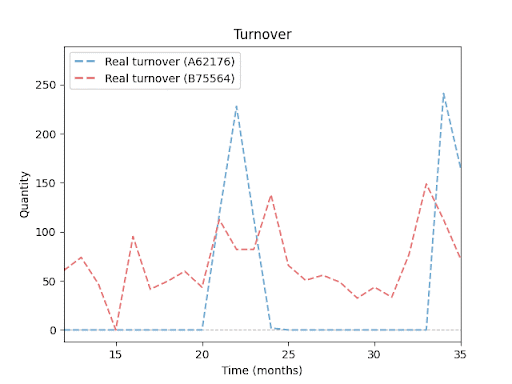
Sales trends over time for various products (SKUs):
The following charts illustrate sales trends for four different products over a 24-month period. Each line shows the sales volume of a single product. You can clearly see how these products differ — in sales volume, seasonal patterns, and even periods with zero sales. These variations highlight why inventory forecasting is hard — and why it requires a much more sophisticated approach than a simple average or basic extrapolation.
To meet the project goals, we first needed to clearly define the specific requirements, constraints, and risks involved. The solution must:
From the beginning, it was clear that the model would face a wide range of challenges:
The objective was not only to build a model that can predict average demand, but also one that can handle these irregular, complex, and often unpredictable scenarios.
Sales History Coverage Table
The sales history table illustrates the variability in how much historical data was available per product.
While the majority of products had a complete 3-year history, a significant portion had only limited or no historical data — posing a major challenge for traditional forecasting models
| Product history length | Number of items | Share of assortment |
|---|---|---|
| 36 months (full history) | 10 105 | 70.00% |
| 12–35 months | 2 668 | 18.00% |
| less than 12 months | 1 211 | 8.00% |
| no history | 519 | 4.00% |
Many companies assume that feeding data into an AI model is enough to get useful results.
As this project showed, the reality is far more complex.
Initial tests revealed that even modern deep learning models (used out of the box) were not sufficient — they struggled with high assortment variability, frequent product turnover, and a large number of zero-sale periods.
The project gradually expanded in scope. It became necessary to:
Today, the model handles most of these challenges automatically, with minimal manual intervention.
| Metric | Value | Business Meaning |
|---|---|---|
| Forecast Accuracy | 80% | How accurately the model predicted future sales. |
| Average Deviation | 48 | Average difference between predicted and actual sales. |
| Mean Absolute Error | 31 | Average size of the error in number of units sold. |
The solution is highly adaptable and can be configured for different clients or datasets.
Most algorithms and core components are predefined and reusable.
While expert knowledge is still required for initial setup and result interpretation, the deployment and validation process is much faster compared to custom development from scratch.
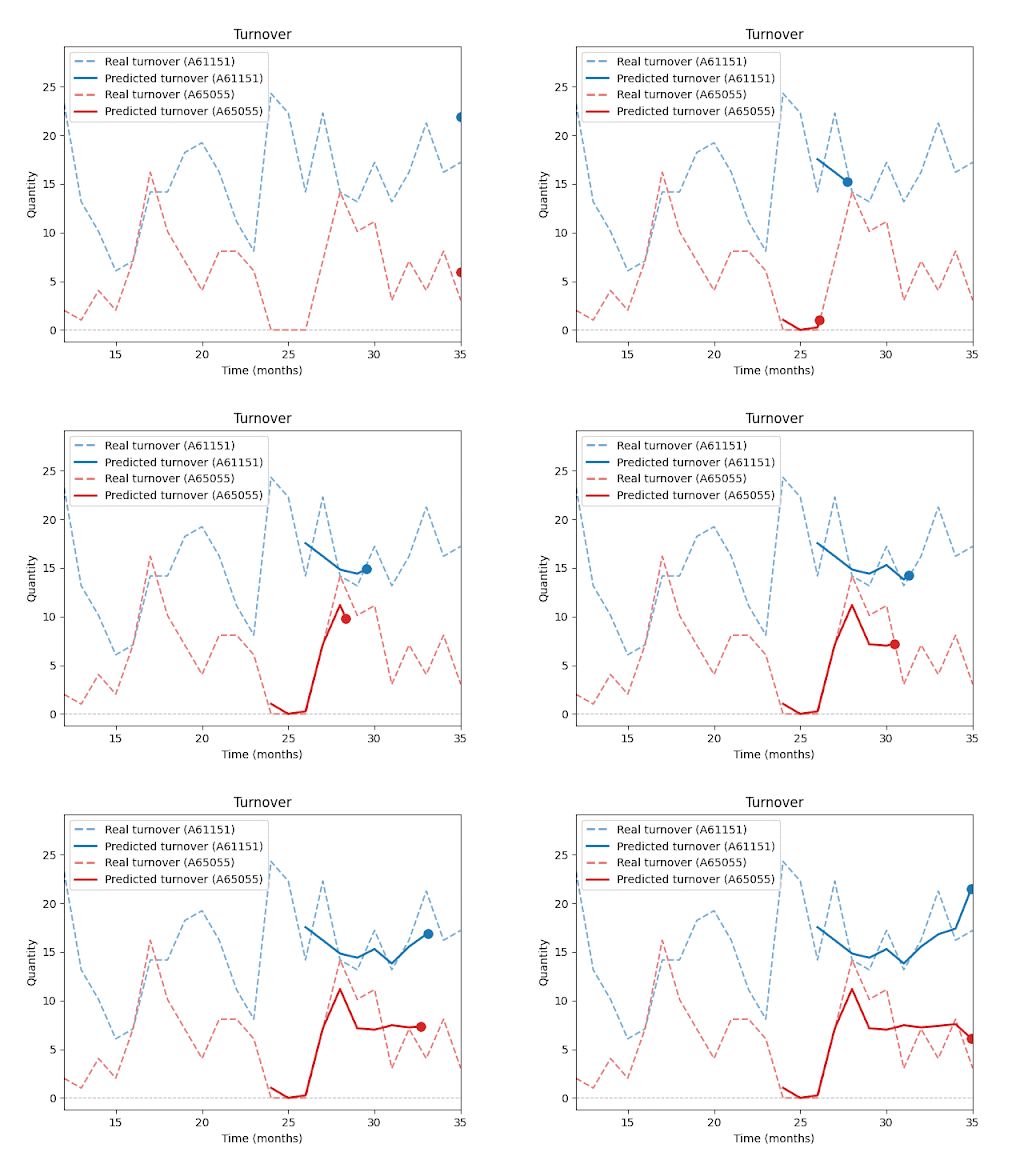
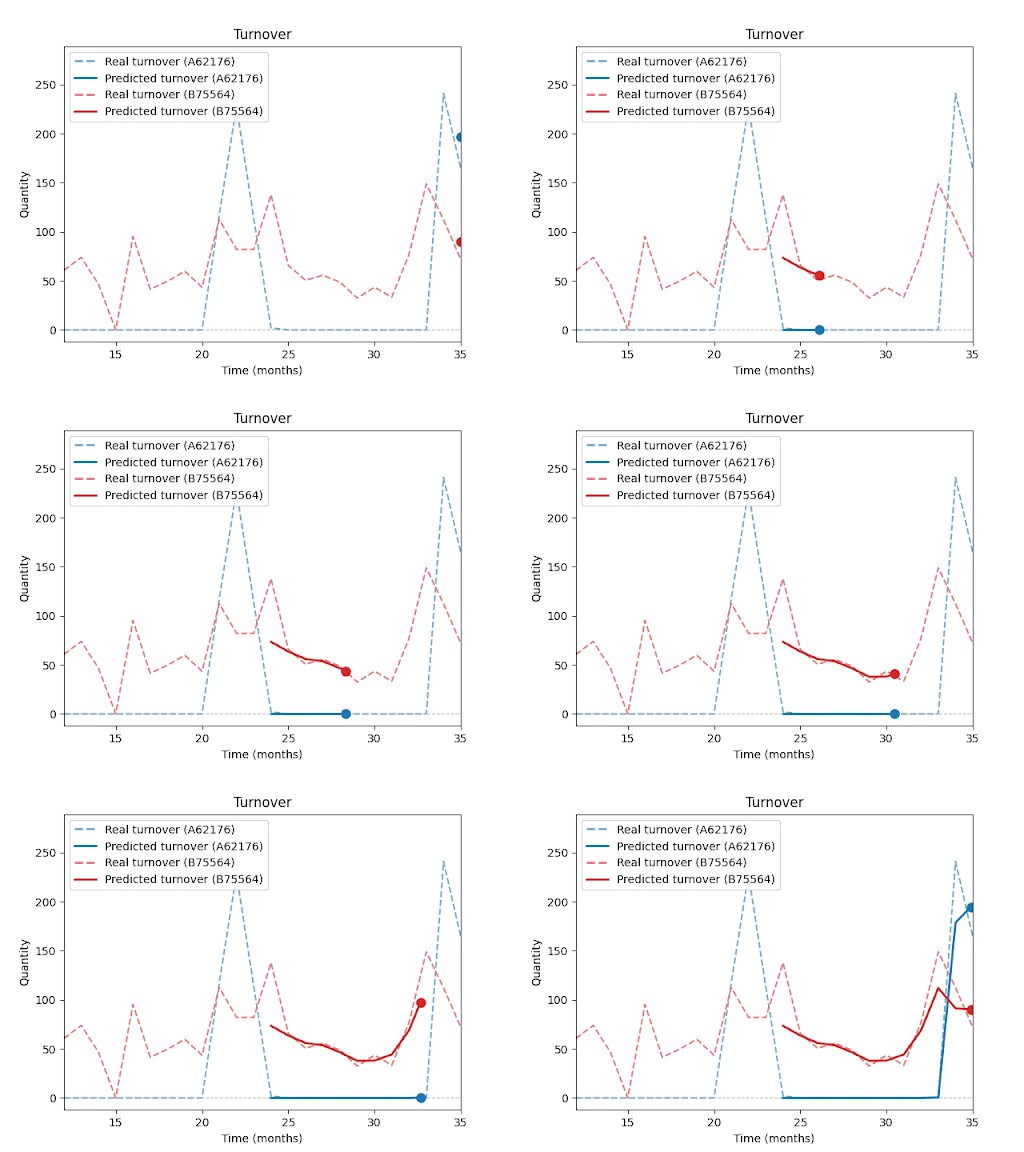
Forecast vs. Reality – Visual Results:
The following charts (not shown here) compare actual vs. predicted sales for selected SKUs.
You can clearly see that the model is able to capture overall sales trends and seasonal fluctuations, even for products with inconsistent histories or irregular sales spikes.At the same time, these charts highlight a key insight: Even with advanced forecasting, a certain level of uncertainty remains, especially during unexpected peaks or drops.
In upcoming parts of this series, I will explore in more detail how forecast performance is influenced by factors such as historical depth, assortment composition, seasonality, and promotions.
The entire project was built on the PyTorch framework, one of the most widely used open-source platforms for deep learning.
Training was done on an NVIDIA RTX 3090 GPU with 24 GB of memory, which made it possible to efficiently handle large-scale datasets and experiment with various scenarios — including models with hundreds of millions of parameters — without significant time delays.
The infrastructure ran on Kubernetes, making the solution easily scalable and portable — it can be deployed on-premises or in the cloud, depending on the client’s needs.
IČO: 172 28 018
DIČ: CZ 172 28 018
Data Box ID: ykwdnxf
sales@neebile.cz
Jičínská 226/17, Praha, Žižkov, PSČ 130 00 Česká republika
(910) 658-2992
© 2025 Vytvořeno DigitalWays
