Too little inventory means stockouts and lost sales. Too much inventory means capital tied up in stock. But how do you forecast something that has virtually no history?
For established products, sales history provides valuable guidance. New products, however, often have no meaningful history at all. Yet businesses still need to make decisions about:
This is exactly where most traditional forecasting approaches reach their limits. If a product has only existed for a few months, there is simply not enough data to reliably describe its behavior. So, is it possible to create a reasonable estimate of future demand without sufficient historical data?
In the following real-world scenarios, I show how forecasting can be approached even when only a limited amount of historical data is available.
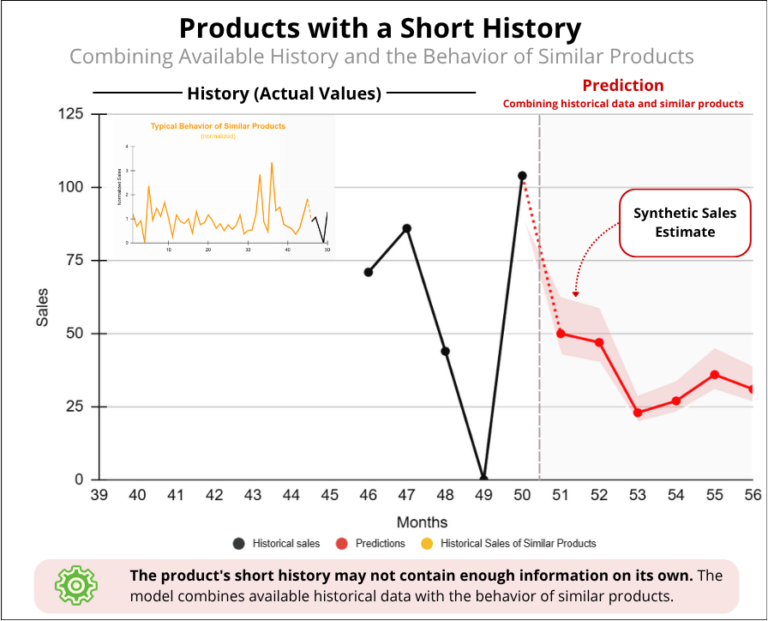
Traditional models often lack sufficient information to generate a reliable forecast. The model therefore uses not only the available product data, but also patterns learned from similar products. For illustration, the typical historical behavior of these products is shown by the orange curve.
In practice, this means one thing: the company does not have to wait another year to accumulate data before it can start planning inventory.
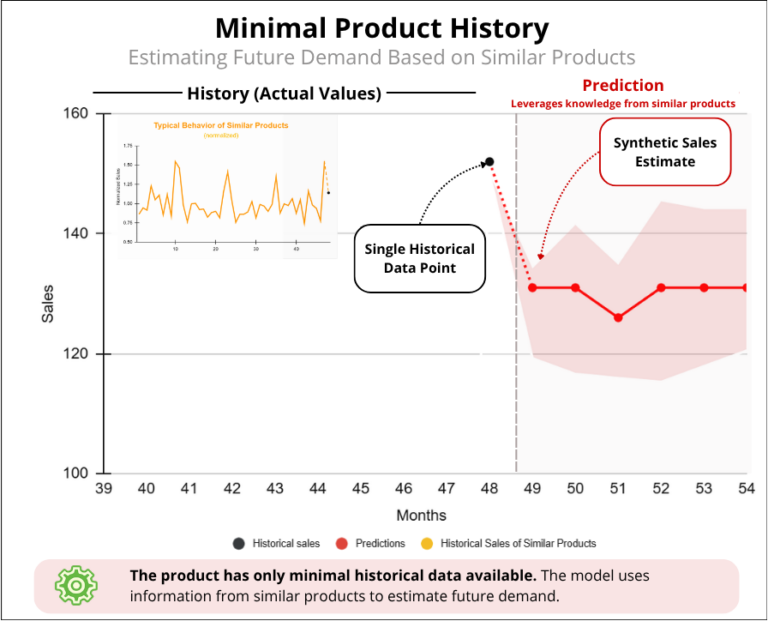
In extreme cases, only one or a few historical observations may be available. From the perspective of traditional forecasting, this is almost an unsolvable problem. Yet inventory decisions often need to be made long before a product builds up enough of its own history.
The model therefore relies primarily on knowledge learned from similar products and their historical development. At the same time, it still requires at least minimal information about the product itself to estimate its baseline demand level.
Similar products can help estimate the expected shape of future demand. However, even a single historical observation can be important for determining whether typical sales occur in tens, hundreds, or thousands of units.
As a result, the company gains an initial estimate of future demand before the product has accumulated a meaningful sales history.
Limited history is one of the most common challenges in forecasting projects. In practice, companies often cannot wait one or two years for a product to accumulate enough historical data for reliable forecasting. This is why it is important to leverage not only the available product history, but also knowledge gained from similar products and historically comparable situations.
It is equally important to understand that the first forecasts for a new product do not represent a precise picture of the future. With very limited history, the forecast is primarily an informed estimate based on similarities to other products. With each new historical observation, the model learns more about the specific product. Over time, it moves from estimating average behavior toward capturing its own unique patterns, seasonality, and other characteristics.
A short history does not mean forecasting is impossible. It simply means there is more uncertainty. Forecasting new products is not about perfect prediction. It is about reducing uncertainty at the moment when information is scarce, but decisions still need to be made.
Note: All examples shown are real model outputs generated from anonymized customer data.
IČO: 172 28 018
DIČ: CZ 172 28 018
Data Box ID: ykwdnxf
sales@neebile.cz
Jičínská 226/17, Praha, Žižkov, PSČ 130 00 Česká republika
(910) 658-2992
© 2025 Vytvořeno DigitalWays
