Today, most companies plan inventory, production, and purchasing based on forecasting. Models typically use historical sales, seasonality, calendars, and external factors such as holidays or weather. There is, however, one factor that is significantly more difficult to model: promotions and marketing support. These can fundamentally change customer behavior.
Sometimes a promotion generates a significant increase in sales. Other times, its impact is barely noticeable. This is exactly why simple rules often fail.
A common approach is: „Add +20% whenever there’s a promotion.“
Reality, however, is far more complex. Different products can respond very differently to the same promotional activity.
In the following real-world scenarios, I show forecasting results where the same type of promotion leads to three completely different outcomes:
Note: For simplicity, the examples use only one type of promotional activity. In practice, promotional effects are often a combination of multiple activities with different intensities and durations. Information about upcoming promotions is known in advance and enters the forecasting process as an additional input.
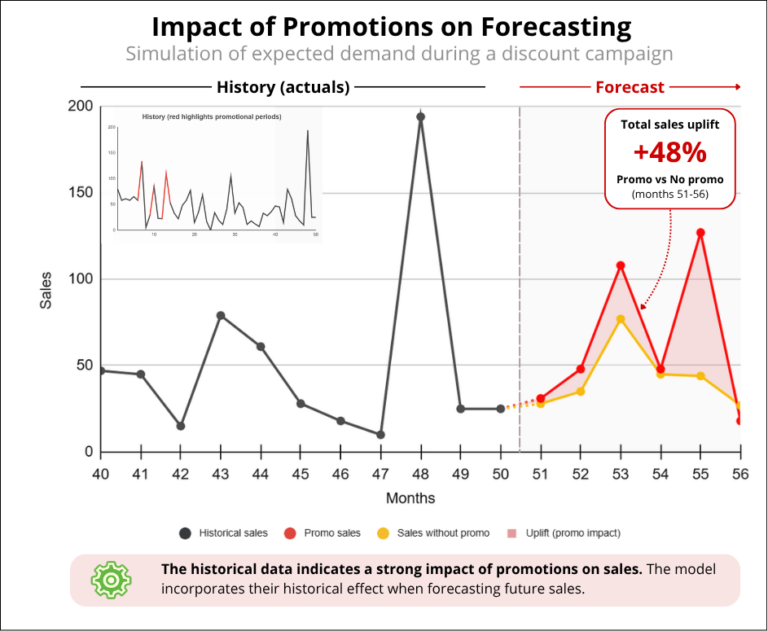
Historical data shows that customers repeatedly respond to promotional campaigns with increased demand. This is not a one-off anomaly but a pattern that appears consistently in the data. The model therefore does not simply project normal demand forward. Instead, it incorporates the historically observed promotional effect. If information about a planned promotion is available in advance, it can be included in the forecast to estimate its likely impact on future demand.
In such situations, ignoring promotional activities can lead to a significant underestimation of future sales and, consequently, inventory shortages during the promotion.
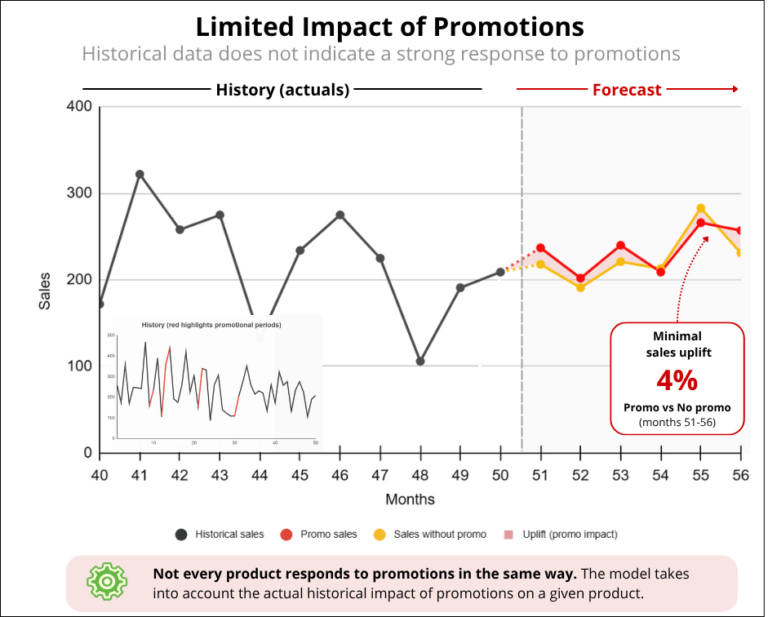
Although the product has historically been promoted, the model does not expect a significant promotional effect in the future. A closer look at the historical data shows that sales during promotional periods were not substantially different from normal fluctuations.
The presence of a promotion does not automatically imply higher demand. If historical data does not show a consistent customer response, there is little reason to expect a significantly different outcome in the future.
In such cases, automatically increasing the forecast simply because a promotion is planned can be risky.
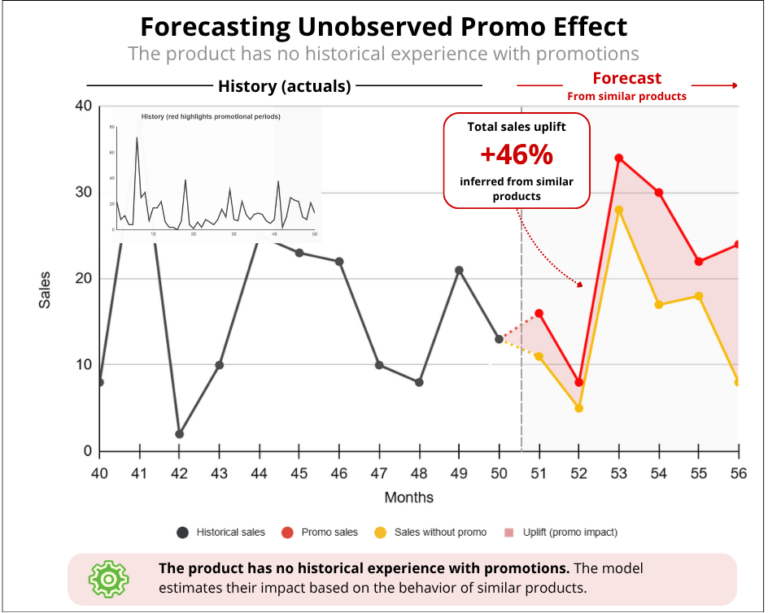
This product has never historically been sold under a promotional campaign. Despite that, the model expects a significant promotional effect.
The reason is not the product’s own history, but knowledge learned from similar products. Those products repeatedly showed increased demand during promotions, and the model was able to transfer that experience to this case.
This does not mean the model “knows” what will happen. It simply leverages historically similar scenarios to estimate how the product might respond to a promotion.
Promotions are not simply a matter of adding a fixed percentage to a forecast. The same discount can produce completely different outcomes across products — from substantial sales growth, to almost no effect, to situations where the impact must be estimated without any direct historical experience.
Promotions themselves are also far more complex than a simple yes/no decision. They differ in discount depth, campaign duration, marketing support, combinations with other campaigns, and timing throughout the year.
As the previous examples demonstrate, the most important factor is not the existence of a promotion itself, but the ability to accurately estimate its actual impact on future demand.
Note: All examples shown are real model outputs generated from anonymized customer data.
IČO: 172 28 018
DIČ: CZ 172 28 018
Data Box ID: ykwdnxf
sales@neebile.cz
Jičínská 226/17, Praha, Žižkov, PSČ 130 00 Česká republika
(910) 658-2992
© 2025 Vytvořeno DigitalWays
