Seasonality is one of the strongest signals in forecasting. When historical patterns repeat consistently, prediction is often relatively straightforward.
In practice, however, multiple effects are often combined:
This is where the main question stops being: „Does seasonality exist?“
and becomes: „How strong is it really, and will it have a similar impact in the future?“
Misjudging a seasonal peak can lead to stock shortages during periods of highest demand or, conversely, excessive inventory outside the season.
In the following real-world scenarios, I demonstrate different types of seasonal behavior and situations where simply repeating last year’s pattern may not be enough.
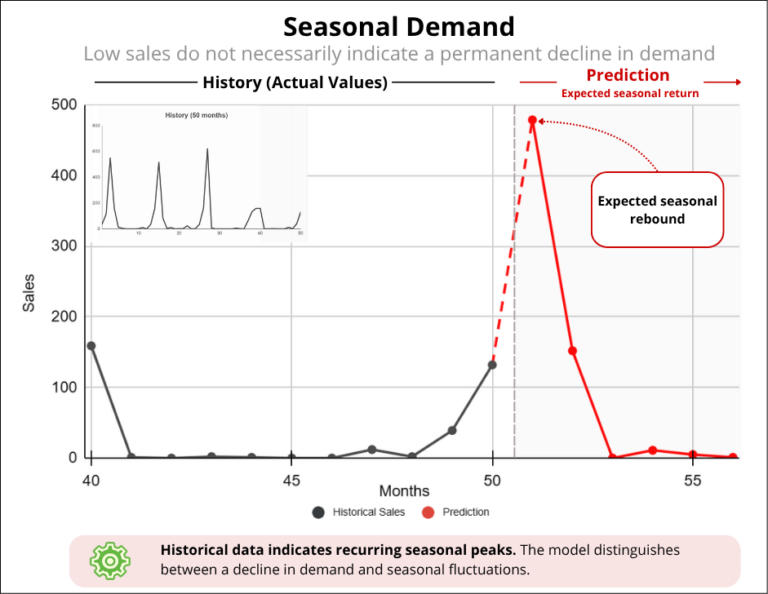
At first glance, a long period of minimal or zero sales may look like the end of demand. However, a longer historical view reveals a recurring pattern — the product generates most of its revenue during a relatively short seasonal period.
The model therefore does not expect low sales to continue indefinitely. Instead, it incorporates the historically recurring seasonal effect and anticipates the return of higher demand. If it relied only on current sales levels, it could classify the product as inactive just before the start of its main season.
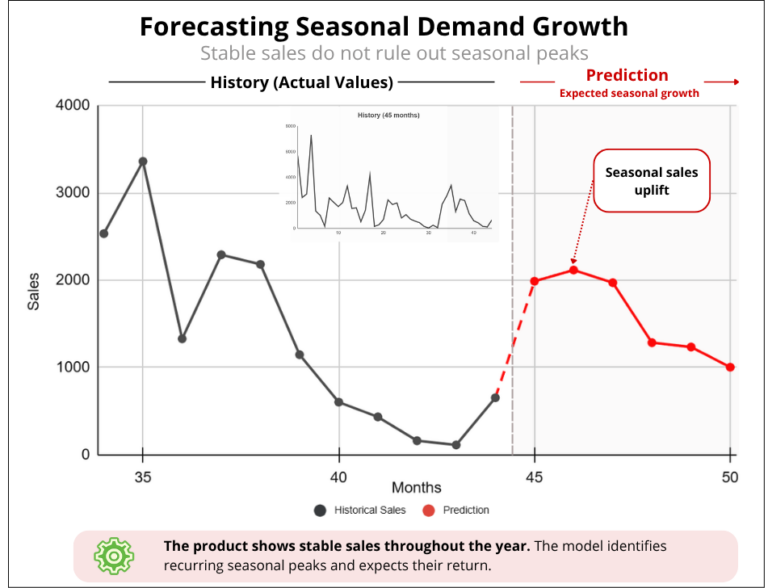
For most products, seasonality does not mean alternating between active sales and zero demand. Sales continue throughout the year, but demand becomes significantly stronger during certain periods.
In this case, the challenge is not identifying the start and end of the season, but correctly estimating its magnitude. The forecast therefore relies not only on current sales levels but also on historically recurring seasonal amplification.
In practice, correctly estimating the size of the seasonal increase is often more important than identifying seasonality itself. Underestimating it can result in stockouts, while overestimating it can leave the company with excess inventory after the season ends.
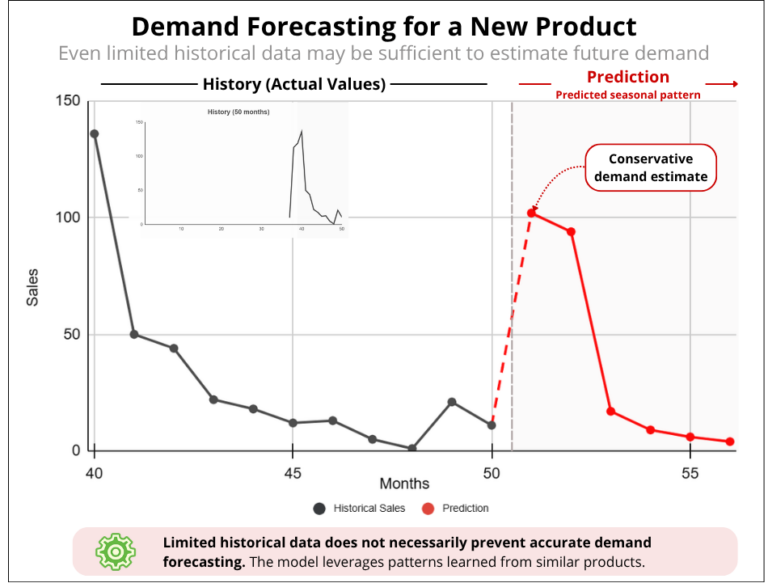
New products often lack enough historical data to capture a full seasonal cycle. Yet businesses may still need to forecast demand before the product experiences another season.
The forecast therefore relies not only on the product’s own history but also on patterns learned from similar products. In this example, the available history contains only one potential seasonal peak, which by itself may not be sufficient to reliably identify a recurring pattern.
Companies often cannot wait for another seasonal cycle before making inventory decisions. The model therefore creates an initial estimate of seasonal behavior even when the product’s own history remains very limited.
Seasonality is one of the strongest signals in forecasting, and in many cases even relatively simple approaches can leverage it successfully. In practice, however, seasonality is often combined with other factors, making prediction significantly more challenging.
In such situations, it is no longer enough to identify the correct period and simply repeat last year’s pattern. The real challenge is estimating when the seasonal effect will occur, how strong it will be, and whether the historical pattern will truly repeat.
As the previous scenarios demonstrate, long periods of low sales do not necessarily mean demand has disappeared, and a single seasonal peak may not be enough to reliably identify future behavior. The biggest challenge is often not determining whether a product is seasonal, but correctly estimating the strength of the season and its actual impact on future demand.
Note: All examples shown are real model outputs generated from anonymized customer data.
IČO: 172 28 018
DIČ: CZ 172 28 018
Data Box ID: ykwdnxf
sales@neebile.cz
Jičínská 226/17, Praha, Žižkov, PSČ 130 00 Česká republika
(910) 658-2992
© 2025 Vytvořeno DigitalWays
